Free Ebook Rhetoric: A Very Short Introduction (Very Short Introductions), by Richard Toye
Why should be this book Rhetoric: A Very Short Introduction (Very Short Introductions), By Richard Toye to review? You will certainly never ever get the expertise and encounter without obtaining by yourself there or trying on your own to do it. For this reason, reviewing this book Rhetoric: A Very Short Introduction (Very Short Introductions), By Richard Toye is needed. You could be great as well as appropriate adequate to obtain exactly how crucial is reading this Rhetoric: A Very Short Introduction (Very Short Introductions), By Richard Toye Also you constantly check out by obligation, you could support on your own to have reading book habit. It will be so useful and enjoyable after that.
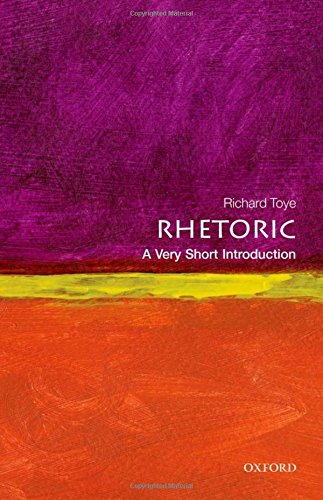
Rhetoric: A Very Short Introduction (Very Short Introductions), by Richard Toye

Free Ebook Rhetoric: A Very Short Introduction (Very Short Introductions), by Richard Toye
Idea in picking the most effective book Rhetoric: A Very Short Introduction (Very Short Introductions), By Richard Toye to read this day can be obtained by reading this resource. You could find the most effective book Rhetoric: A Very Short Introduction (Very Short Introductions), By Richard Toye that is sold in this world. Not only had actually the books released from this nation, but additionally the other countries. As well as currently, we mean you to read Rhetoric: A Very Short Introduction (Very Short Introductions), By Richard Toye as one of the reading materials. This is only one of the very best books to collect in this site. Take a look at the web page and also search guides Rhetoric: A Very Short Introduction (Very Short Introductions), By Richard Toye You can locate bunches of titles of guides provided.
If you ally need such a referred Rhetoric: A Very Short Introduction (Very Short Introductions), By Richard Toye book that will provide you worth, obtain the best seller from us currently from numerous prominent publishers. If you intend to entertaining books, several stories, story, jokes, and a lot more fictions compilations are also released, from best seller to one of the most recent released. You might not be confused to appreciate all book collections Rhetoric: A Very Short Introduction (Very Short Introductions), By Richard Toye that we will give. It is not concerning the prices. It's about what you require now. This Rhetoric: A Very Short Introduction (Very Short Introductions), By Richard Toye, as one of the most effective sellers below will be among the best choices to read.
Locating the ideal Rhetoric: A Very Short Introduction (Very Short Introductions), By Richard Toye publication as the right necessity is type of good lucks to have. To begin your day or to end your day at night, this Rhetoric: A Very Short Introduction (Very Short Introductions), By Richard Toye will certainly appertain sufficient. You can merely hunt for the floor tile right here and also you will certainly obtain guide Rhetoric: A Very Short Introduction (Very Short Introductions), By Richard Toye referred. It will certainly not trouble you to cut your valuable time to go with purchasing book in store. By doing this, you will certainly also spend cash to spend for transportation and also various other time spent.
By downloading the on the internet Rhetoric: A Very Short Introduction (Very Short Introductions), By Richard Toye publication right here, you will certainly get some advantages not to go with guide establishment. Simply attach to the internet as well as begin to download the web page link we share. Currently, your Rhetoric: A Very Short Introduction (Very Short Introductions), By Richard Toye is ready to take pleasure in reading. This is your time as well as your serenity to get all that you desire from this publication Rhetoric: A Very Short Introduction (Very Short Introductions), By Richard Toye
Rhetoric was once an essential part of western education. Aristotle wrote an important treatise on it and Demosthenes remains famous to this day for his skills as a rhetorician. But skill with rhetoric today is no longer admired. Rhetoric is often seen as a synonym for shallow, deceptive language-empty words, empty rhetoric--and therefore as something quite negative. But if we view rhetoric in more neutral terms, as the "art of persuasion," it is clear that we are all forced to engage with it at some level, if only because we are constantly exposed to the rhetoric of others. In this Very Short Introduction, Richard Toye explores the purpose of rhetoric. Rather than presenting a defense of it, he considers it as the foundation-stone of civil society, and an essential part of any democratic process. Using wide-ranging examples from ancient Greece, medieval Islamic preaching, the wartime speeches of Winston Churchill, and modern cinema, Toye considers why we should all have an appreciation of the art of rhetoric.
About the Series:
Oxford's Very Short Introductions series offers concise and original introductions to a wide range of subjects--from Islam to Sociology, Politics to Classics, Literary Theory to History, and Archaeology to the Bible. Not simply a textbook of definitions, each volume in this series provides trenchant and provocative--yet always balanced and complete--discussions of the central issues in a given discipline or field. Every Very Short Introduction gives a readable evolution of the subject in question, demonstrating how the subject has developed and how it has influenced society. Eventually, the series will encompass every major academic discipline, offering all students an accessible and abundant reference library. Whatever the area of study that one deems important or appealing, whatever the topic that fascinates the general reader, the Very Short Introductions series has a handy and affordable guide that will likely prove indispensable.
- Sales Rank: #191062 in Books
- Published on: 2013-05-08
- Original language: English
- Number of items: 1
- Dimensions: 4.40" h x .50" w x 6.70" l, .55 pounds
- Binding: Paperback
- 136 pages
Review
Rhetoric matters. To explicate this shaggy beast in 35,000 words is no small challenge, and Toye succeeds with a consistently light touch. The Speechwriter
About the Author
Richard Toye is Professor of Modern History at the University of Exeter. His books include Lloyd George and Churchill: Rivals for Greatness and Churchill's Empire: The World That Made Him and the World He Made.
Most helpful customer reviews
23 of 25 people found the following review helpful.
Exactly as advertised: an introduction. Not a how-to, but a description
By Graham H. Seibert
Rhetoric is the art of speaking. The Greeks both prized and despised it. Plato gave the Sophists and rhetoricians a bad name which has endured for two and a half millennia, yet rhetoric has been part of any standard curriculum in the West for much of that time.
It is well known that there is a vast difference between the truth of an argument and its persuasive power. Lawyers have always been suspect: they say whatever they need in order to win. All of America thought that O. J. Simpson murdered his wife, but skillful rhetoric by his attorney Johnnie Cochran got him acquitted. As far back as Machiavelli, lying and rhetoric have been recognized as essential tools of statecraft.
Rhetoric appeals to three aspects of self: logos, ethos and pathos. The Greeks named them - they have been studied ever since. The first is logic - the quality of an argument itself. The second is an appeal to character, or ethics. The third is an appeal to the emotions, i.e., "You can't execute this triple murderer- he's just a boy."
Toye identifies three ages of rhetoric. An oral age, that of the Greeks, when few people read and wrote, and argument was therefore spoken. It was followed by a literary age, after the invention of the printing press, when authors were able to start to use longer constructions and more sophisticated vocabularies suited to reading. It was also a time when the topics of argument became more complex: public policy involved schools and bond issues as often as wars. It is followed by a second oral age, today, which started just short of a century ago with radio, and has accelerated with the spread of TV and the extension of the voting franchise to just about anybody who owns one.
Toye offers an invitation to analyze texts for use of the classical rhetorical devices such as the tricolon and antithesis. He suggests looking closely at the structure of arguments, oral or written. Tricks: "Have you stopped beating your wife?" One of the most valuable aspects of the book is the set of problems he poses for the reader, opportunities to explore how rhetoric is used now and in history.
Words alone do not carry the argument. He offers a discussion of the nonverbal aspects of speech: voice, gesture, and the choice of clothing, venue, backdrop and anything else that will visually sway the audience.
Rhetoric depends on the shared values and culture of the audience. A British political speech is pitched at fellow members of the legislature; a speech by the American President nowadays bypasses Congress, working to sway the electorate to put pressure on their Congressmen.
Words never mean just one thing. Context and time are always important. He cites literary theory and deconstruction - Foucault and Richards et al. He does not get into semantics. Others such as Chomsky, Hayakawa and Wittgenstein have a lot to say about the meaning of words, and how much meaning they contain. Kahneman, Trivers and Ariely among others have looked deeply into self-deception, which often means, of course, allowing oneself to be deceived by appealing rhetoric.
The book is erudite while still being easy to read. The work of a man very comfortable with the language, as one would hope. A pleasant, quick read.
Rhetoric stresses the importance of what is not said. There is a modern campaign, a highly successful one, to rule out discussion of certain topics. They are not resolved, they simply remain unarguable by serious contenders. However, PC goes in and out of fashion. As a book title says of communism, "Everything Was Forever, Until It Was No More"
Conclusion - Read if for exactly what it claims to be, a short introduction. It is also a defense, and a justification for the study of rhetoric for the sake of recognizing and defending yourself against rhetorical questions (viz, my wife had me smell her wrist yesterday and asked "Honey, do I deserve this $200 perfume?"). If you want to practice the tricks yourself, there are many "How to" books about rhetoric, on everything from the art of seducing women, from Ovid through RoushV (whom I review), to the art of seducing voters.
10 of 10 people found the following review helpful.
A good informative read
By Sussman
This is my first foray into the series `A Very Short Introductions'. I was intrigued by the premise that these titles were intended to give the reader a jump start in subject in a reasonably short, straight forward and concise fashion. The topic here, being `Rhetoric' the ability for people through speech or the written word to attempt to enlighten, influence, or encourage particular audiences in specific situations to their point of view/theory. For me the book seemed to given over more the take of the subject through history and its importance as a subject of formal study and a productive civic practice, and the role that rhetoric has played with in the Western tradition. Like other reviewers have commented I found it initially a hard book to get into, but once there I felt the `journey' was worthwhile. All in all a good productive read and hence my 4 star rating.
3 of 3 people found the following review helpful.
The Process of Discovery
By Kevin L. Nenstiel
Back in my teaching days, I premised my lesson plans on rhetoric but, like many new teachers, I had less background than I would've liked. I purchased books and pricy downloads to supplement my knowledge, struggling to stay one step ahead of my students. But the sources for which I paid dearly generally assumed you already had prior familiarity with other aspects of rhetorical theory. Why, I wondered, pulling my hair, doesn't somebody write a synoptic overview so beginners know where to begin researching?
I wish this book existed when I started teaching, nearly a decade ago. The book offers exactly what the title suggests, a brief primer to rhetoric as an academic discipline. This includes a thumbnail history of important moments and important texts, a survey of important rhetorical practices, a concise handlist of the most common rhetorical devices, and a pithy introduction to rhetorical analysis. Basically, it guides readers through the discipline without falling back on jargon or assuming we have any prior familiarity with the field.
Possibly my favorite part comes closer to the end. Having spent early chapters introducing readers to the discipline's history, and giving us an overview of the parts everybody largely agrees upon, Professor Toye shifts to recent developments and ongoing research. He admits that the ancient Greco-Roman dream of a universal, invariable science of persuasion (the roots of rhetoric) will probably never happen. But he guides us through recent advances in social science and technological progress, and says, if rhetoric will never be a science, it's nevertheless a fertile field for new research.
The text includes brief exercises for individual or group study. These are just brief attempts to put rhetorical principles into useful context; this isn't a textbook for classroom study, though a dedicated teacher could use it that way. Instead, it's an attempt to give current or potential students a shared vocabulary of prior assumptions, so that when we get into the actual textbooks—which, if you look at them, subdivide quickly into numerous sub-specialties—we have basic agreement on what words mean, and enough background to know where to focus our energy.
Rhetoric, as an academic discipline, has seen a remarkable rebirth in America in the last thirty years. Professor Toye, British himself, admits the UK hasn't embraced this trend yet, but recent changes suggest it may soon. Far from being mere bombast or tedious ornamentation, the ideas we mean when we dismiss "mere rhetoric," the process of arranging ideas persuasively is a discipline that helps create and advance new ideas. The ancients called rhetoric "discovery" for a reason. And this brief precis will let you join the discussion.
Rhetoric: A Very Short Introduction (Very Short Introductions), by Richard Toye PDF
Rhetoric: A Very Short Introduction (Very Short Introductions), by Richard Toye EPub
Rhetoric: A Very Short Introduction (Very Short Introductions), by Richard Toye Doc
Rhetoric: A Very Short Introduction (Very Short Introductions), by Richard Toye iBooks
Rhetoric: A Very Short Introduction (Very Short Introductions), by Richard Toye rtf
Rhetoric: A Very Short Introduction (Very Short Introductions), by Richard Toye Mobipocket
Rhetoric: A Very Short Introduction (Very Short Introductions), by Richard Toye Kindle

Tidak ada komentar:
Posting Komentar